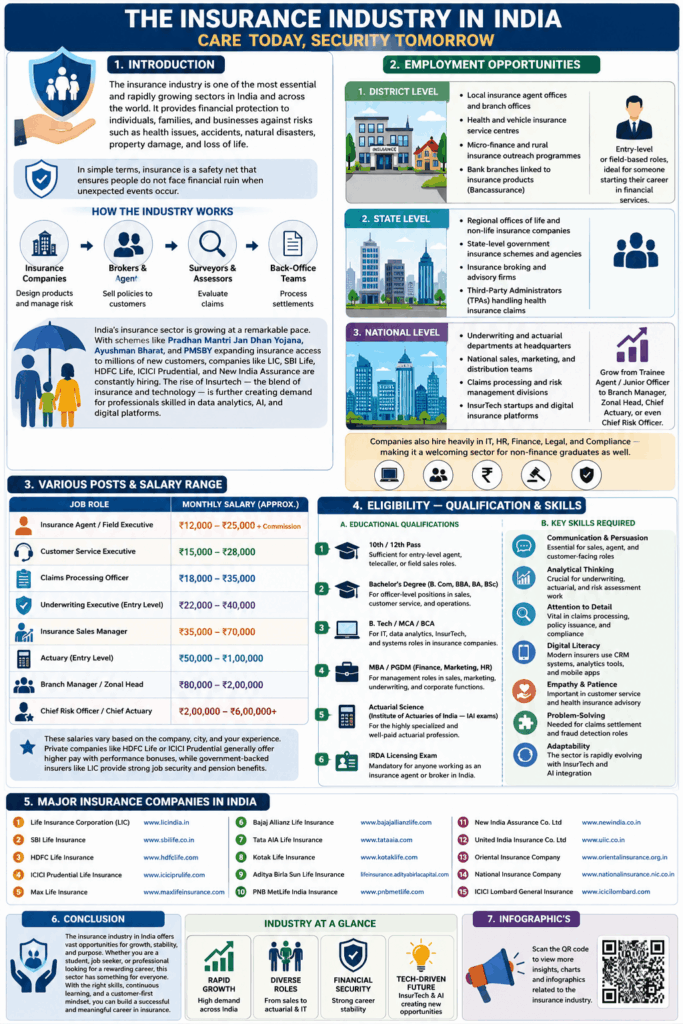

Introduction: What Is the Insurance Industry and How Does It Work?
The insurance sector is one of India’s most essential and fastest-growing industries — and one of the best-kept secrets for ambitious job seekers. At its core, insurance is a financial safety net: individuals, families, and businesses pay regular premiums to an insurer, who in return covers their losses when unexpected events — accidents, illness, natural disasters, or death — occur.
The industry operates as a well-connected chain. Insurance companies design products and manage risk. Brokers and agents sell policies to customers. Surveyors and assessors evaluate claims. Back-office teams process settlements. At every link in this chain, skilled professionals are in demand — making insurance sector jobs some of the most diverse and stable career options available today.
Industry Insight: India’s insurance penetration is still well below the global average, which means the sector has enormous room to grow — and a growing need for talent at every level.
Government schemes like Ayushman Bharat, Pradhan Mantri Jan Dhan Yojana, and PMSBY have brought millions of new customers into the insurance fold. Meanwhile, the rise of InsurTech — the fusion of insurance and technology — is creating fresh demand for professionals skilled in data analytics, AI, and digital platforms. This is not a stagnant industry; it is one that is actively reinventing itself.
Employment Opportunities: A Career Landscape Across Every Level
One of the biggest advantages of a banking and insurance career path is that opportunities exist at every geographic level — from your own district to the national stage.
District Level: Where Careers Begin
For those just starting out, entry-level and field-based roles are widely available locally:
- Local insurance agent offices and branch offices
- Health and vehicle insurance service centres
- Micro-finance and rural insurance outreach programmes
- Bank branches linked to insurance products (Bancassurance)
These roles are ideal for fresh graduates or 12th-pass candidates looking to enter the financial services world without relocating.
State Level: Stepping Up the Ladder
As you gain experience, state-level opportunities open up:
- Regional offices of life and non-life insurance companies
- State-level government insurance schemes and agencies
- Insurance broking and advisory firms
- Third-Party Administrators (TPAs) handling health insurance claims
These mid-tier roles often come with better salaries, structured training, and clearer paths to promotion.
National Level: The Corporate Arena
At the national level, the insurance career path expands into high-value corporate roles:
- Underwriting and actuarial departments at company headquarters
- National sales, marketing, and distribution teams
- Claims processing and risk management divisions
- InsurTech startups and digital insurance platforms
Career Tip: You can grow from a trainee agent or junior officer all the way up to Branch Manager, Zonal Head, Chief Actuary, or even Chief Risk Officer. The sector also hires heavily in IT, HR, Finance, Legal, and Compliance — welcoming non-finance graduates too.
Hierarchical Tiers at a Glance
Level | Typical Roles |
Entry-Level | Insurance Agent, Telecaller, Field Executive, Customer Service Executive |
Mid-Level | Claims Officer, Underwriting Executive, Sales Manager |
Senior-Level | Branch Manager, Regional Head, Actuarial Analyst |
Top Management | Zonal Head, Chief Risk Officer, Chief Actuary |
Various Posts & Roles: Responsibilities and Salary Ranges
The insurance sector job market is broad. Whether you are a people person, a numbers expert, or a tech enthusiast, there is a role that fits your strengths. Below is a breakdown of key roles, what they involve, and what you can expect to earn.
Job Role | Key Responsibilities | Monthly Salary (Approx.) |
Insurance Agent / Field Executive | Selling policies, client acquisition, lead generation | ₹12,000 – ₹25,000 + Commission |
Customer Service Executive | Handling queries, policy renewals, grievance resolution | ₹15,000 – ₹28,000 |
Claims Processing Officer | Reviewing and settling insurance claims, documentation | ₹18,000 – ₹35,000 |
Underwriting Executive | Risk assessment, policy pricing, approval decisions | ₹22,000 – ₹40,000 |
Insurance Sales Manager | Leading sales teams, target management, strategy | ₹35,000 – ₹70,000 |
Actuary (Entry Level) | Statistical modelling, risk calculations, pricing | ₹50,000 – ₹1,00,000 |
Branch Manager / Zonal Head | Operations oversight, P&L management, team leadership | ₹80,000 – ₹2,00,000 |
Chief Risk Officer / Chief Actuary | Enterprise risk strategy, regulatory compliance | ₹2,00,000 – ₹6,00,000+ |
Important Note: Salaries vary based on company, city, and experience. Private insurers like HDFC Life and ICICI Prudential typically offer higher pay with performance bonuses, while government-backed insurers like LIC provide strong job security and pension benefits.
Eligibility Criteria: Qualifications and Skills You Need
Breaking into insurance sector jobs does not require a single fixed qualification. The industry welcomes candidates from a wide range of educational backgrounds.
Academic Qualifications
- 10th / 12th Pass — Sufficient for entry-level agent, telecaller, or field sales roles
- Bachelor’s Degree (B.Com, BBA, BA, BSc) — Required for officer-level positions in sales, customer service, and operations
- B.Tech / MCA / BCA — Ideal for IT, data analytics, InsurTech, and systems roles
- MBA / PGDM (Finance, Marketing, HR) — Opens doors to management roles in sales, underwriting, and corporate functions
- Actuarial Science (IAI Exams) — The gateway to the highly specialised and well-paid actuarial profession
- IRDA Licensing Exam — Mandatory for anyone working as an insurance agent or broker in India
Essential Skills for Insurance Careers
Hard Skills:
- Analytical thinking for underwriting, actuarial, and risk assessment roles
- Digital literacy: CRM systems, analytics tools, and mobile platforms
- Knowledge of IRDA regulations and compliance frameworks
Soft Skills:
- Communication and persuasion — essential for every client-facing role
- Attention to detail — vital in claims processing, policy issuance, and compliance
- Empathy and patience — particularly important in health insurance advisory
- Problem-solving — needed for claims settlement and fraud detection
- Adaptability — the sector is evolving rapidly with InsurTech and AI integration
Pro Tip: Even if you don’t come from a finance background, a strong combination of digital literacy and communication skills can launch a rewarding entry-level insurance career in customer service, tech support, or HR within a major insurer.
The insurance industry is not just about selling policies — it is a world of opportunity for anyone willing to learn and grow. With India’s insurance penetration well below the global average, the demand for skilled professionals is set to rise significantly in the coming decade.